• Skip to primary navigation
  • Skip to content
  • Skip to footer

Westside Communities Alliance

A partnership between Atlanta's westside communities and institutions of higher education.

  • Home
  • About
  • Initiatives
    • Data Dashboard
    • Westside Resource Center
    • Technology Enterprise Park
  • Stories
  • Community
  • Volunteer
  • Calendar

Location Affordability Portal

August 7, 2014 by Mackenzie Madden

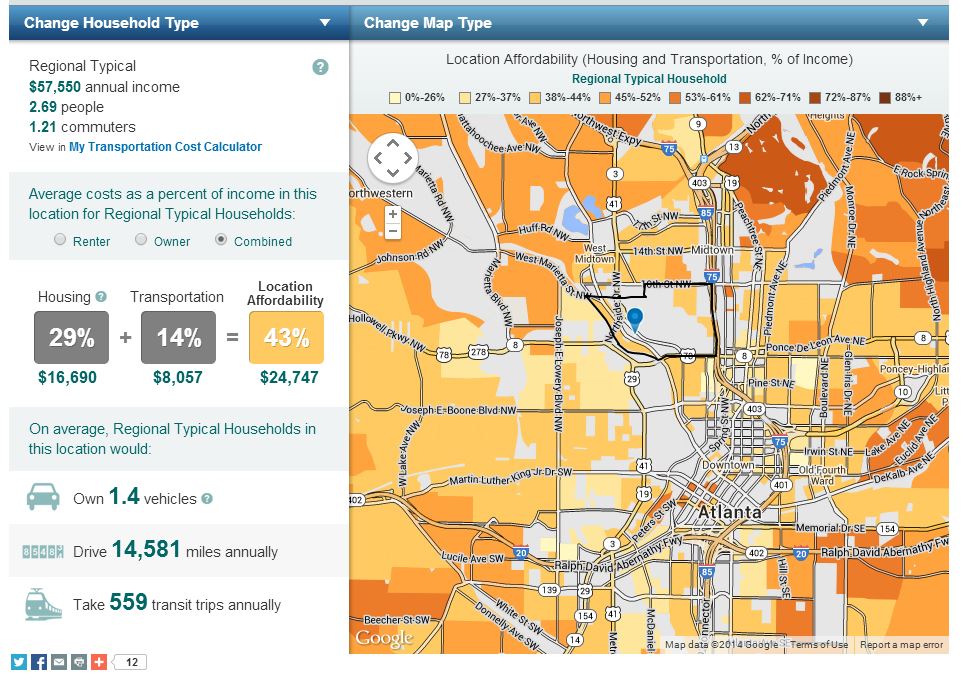
The WCA office according to the Location Affordability Index.

 
[clear]
On July 16th, WCA staff was present at the Version 2 Pre-Launch of the Location Affordability Portal. The portal is a product of Sustainable Communities, the partnership between the Department of Transportation, Environmental Protection Agency, and Department of Housing and Urban Development and the launch was one of only two throughout the nation.

Research shows that the average American family spends 52 cents of every dollar is spent on housing and transportation. The tool is intended to give families an extra metric for decision-making when it comes to choosing where to live and work. It combines the Location Affordability Index and the My Transportation Cost Calculator to provide the public with access to data on housing and transportation costs.

Cicely Garrett, of the Atlanta Community Food Bank, made a good point to the presenter about one fallacy of the tool: not taking into account the value of time. Especially here in Atlanta, where the rail system is less extensive than other cities, a wait for a bus, a transfer, and a ride on the train may take significantly longer than a ride in a car. Josh Geyer of the HUD Office of Economic Resilience, argues that time spent on public transit can be better utilized than time spent driving a car.

To use the portal, simply go to http://www.locationaffordability.info/ where you can explore both tools. In the Location Affordability Index, you can view annual averages (including number of residents per unit, number of vehicles owned, vehicle miles traveled, and transit trips) for your region by inputting your address.

The Transportation Cost Calculator creates a profile for you and your family based on where you live and work and how often you use a car compared to transit. You can even make multiple profiles for different housing or work options to see how one location compares to another in terms of affordability.

See highlight statements from the second panel: LAP_Panel2

See hand-out from the event: LAPhandouts.
Filed Under: Development, News, Transit

NCA Meeting on May 21st, 2014

May 27, 2014 by Mackenzie Madden

journalist


Last Wednesday, WCA staff attended the Northwest Community Alliance’s 2nd Reporter’s Panel featuring local journalists. There was lively discussion about the future of media and journalism, the current state of affairs in Atlanta, the history of development in the city, the role of anchor institutions in economic development and much more. Please see the notes for more detailed comments and questions.

NCA_May21_2014

Filed Under: Building an Alliance, Development, News, Stories

Arthur M. Blank Foundation Accepting Grant Requests for the Westside

April 24, 2014 by Mackenzie Madden

http://saportareport.com/blog/2014/04/blank-foundation-now-taking-grant-requests-for-15-million-westside-fund/

Saporta Report: Blank Foundation now taking grant requests for $15 million Westside fund

Author M. Blank Foundation - Funding Opportunity
Author M. Blank Foundation – Funding Opportunity

Posted in Latest Reports

Date: April 22nd, 2014, 2:36 pm

By Maria Saporta

The Arthur M. Blank Family Foundation is ready to accept grant applications to its $15 million Westside Neighborhood Prosperity Fund.

The Blank Foundation committed $15 million to help transform the neighborhoods of Vine City, English Avenue and Castleberry Hill last year when it was seeking approvals to get the new Atlanta Falcons stadium built south of the existing Georgia Dome. The city’s Invest Atlanta arm also committed $15 million from its Westside Tax Allocation District to those communities.

Frank Fernandez, vice president of community development for the Blank Foundation, announced Tuesday that it is now accepting grant applications from nonprofits interested in helping transform those communities.

“Because this is a place-based initiative, it is about finding community partners to help transform the area into what we all want it to be,” Fernandez said in a telephone interview Tuesday afternoon. “We are going to be looking for leverage. That is important. We will make investments that we believe will be catalysts for the community.”

The grants will have a rolling deadline. The first step is that interested organizations must pass the “eligibility quiz.” They must be a nonprofit entity, and they must be able to provide products or services in the designated areas. The second part of the process will be to submit an initial grant inquiry to see if their request would be a good fit.

And the third step would be a full grant application, if the organization is invited to apply, said Fernandez, who has been in his position for two-and-a-half months.

“We will favor groups that have the capacity to work with those who are already in the area,” Fernandez said, adding that they hope to be able to strike an appropriate balance of outside skill and expertise with local neighborhood knowledge and understanding.

The plan will be to post the different grant awards on the Blank website and make the process as transparent as possible. The Blank Foundation also plans to be “embedded in the community” and expects to be a partner with the grant partners.

Here is what the Blank Foundation is sending out on Tuesday:

Westside Neighborhood Prosperity Fund: Now Accepting Grant Inquiries

The Westside of Atlanta has a rich history, steeped in the civil rights movement, home to Dr. Martin Luther King, Jr. Unfortunately, over the last several decades this once vibrant community has been overwhelmed by concentrated poverty, blight and disillusionment—leaving residents and non-residents frustrated by the lack of positive change. We at the Arthur M. Blank Family Foundation are committed to working with the Westside community to re-imagine what is possible and help create a place where everyone has a fair shot at a decent life. This type of transformative change will require a team effort with strong partnerships among community members, public officials and local businesses. We look forward to working together to make change happen.

Westside Neighborhood Prosperity Fund: $15 million Investment

The Arthur M. Blank Family Foundation is excited to officially open up the Westside Neighborhood Prosperity Fund. Our $15 million investment in the Westside and its residents will help the Vine City, English Avenue and Castleberry Hill communities become safer, healthier and more prosperous. Our grants will focus on the areas these communities have said are most important to them—economic development, improved safety and lower crime, better education and a greater focus on healthy communities. These grants will be awarded to organizations that have the capacity to run transformational projects and programs that offer lasting impact. Grants will focus on:

Helping community members receive the training and opportunities they need to secure stable, good-paying jobs or start small businesses;

Creating a safer environment that will lead to lower crime and a greater sense of community;

Increasing and improving the educational opportunities available to kids in these neighborhoods;

Providing safe, quality, affordable housing for long-time residents who need assistance;

Improving the ability of local residents to live healthier lives in healthier environments; and

More broadly, connecting neighborhood residents to the socio-economic opportunities they need to succeed.

Capacity Building Program

In the next few months, The Arthur M. Blank Family Foundation also plans to launch a Capacity Building Program to help smaller neighborhood-based organizations increase their impact. We recognize that neighborhood residents and groups have been positively affecting the lives of their neighbors for years with limited resources and capacity. We value their contribution and want to invest in them to help grow their capacity to play a larger role in creating the transformative change we all want to see.

If you are interested in learning more about the Capacity Building Program when it is launched please click here.

Application Process 
The Westside Neighborhood Prosperity Fund grant application process is straightforward and consists of three steps: 1) taking an eligibility quiz; 2) submitting an initial grant inquiry; and 3) submitting a full grant application, if invited to apply.

Please click here to learn more about our grant application process.

By working together, The Arthur M. Blank Family Foundation believes that 
transformative change will come, connecting the Westside and its residents to 
Atlanta’s broader prosperity.


Filed Under: Development, News Tagged With: Blank Foundation, funding, Grant, Westside

Quilting Workshop – April 27th

April 22, 2014 by Mackenzie Madden

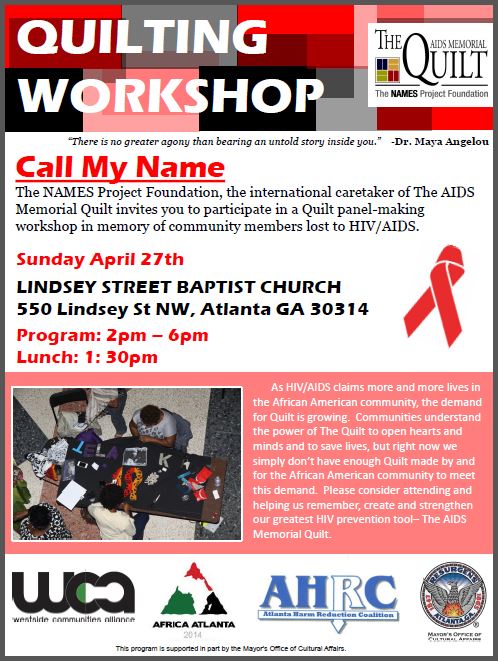
The NAMES Project Foundation, the international caretaker of The AIDS Memorial Quilt, invites the public to gather to create new Quilt panels for members of the community lost to HIV/AIDS.  This is a free, panel making workshop titled “Call My Name” and will be hosted by AIDS Memorial Quilt Curator Jada Harris and Julie Rhoads, President & CEO of The NAMES Project Foundation.

The “Call My Name” workshop will be presented on Sunday April 27th 2014, at the Lindsey Street Baptist Church (550 Lindsey St NW, Atlanta GA 30314) from 2:00 pm – 6:00 pm.  No sewing experience is necessary and materials will be provided. Williams explains, “We have all been touched by HIV/AIDS and by creating a panel for The Quilt, we, as a community, are honoring those we have lost and we are transforming that loss into something that offers hope and can keep others safe from this horrible disease.”

QuiltingWorkshopFlyer

The AIDS Memorial Quilt was created one 3 x 6 foot panel at a time by more than 100,000 individuals from across the country and around the world. With everything from teddy bears to wedding rings, B

oy Scout badges to love letters, the more than 48,000 handmade panels that comprise The Quilt are as varied as the individuals they honor and the people who created them.  Each year, sections of The Quilt are presented in nearly 1,000 displays around the world — in community centers, schools, places of worship, corporations, etc. — in an effort to share the messages of hope, healing and action found on The Quilt.

As HIV/AIDS claims more and more lives in the African American community, the demand for Quilt is growing.  Communities understand the power of The Quilt to open hearts and minds and to save lives, but right now we simply don’t have enough Quilt made by and for the African American community to meet this demand.  Atlanta Harm Reduction Coalition (AHRC), a partner on this project, uses the harm reduction model as a key prevention tool to fight the transmission of HIV and other blood borne diseases. Please consider attending and helping us remember, create and strengthen our greatest HIV prevention tool– The AIDS Memorial Quilt.

This program is supported in part by the Mayor’s Office of Cultural Affairs, the Westside Communities Alliance, and Africa Atlanta 2014. For more information on the “Call My Name” workshops, please go to aidsquilt.org/callmyname or e-mail sheridf@iac.gatech.edu.

Filed Under: Arts, Building an Alliance, Church, Culture, Events, Health, News, Principles, Stories, Westside Stories

Urban Agriculture Zoning Ordinance

March 26, 2014 by Mackenzie Madden

TLW

The zoning committee of Atlanta City Council recently introduced Z-14-05/14-02-05, an ordinance to amend the 1982 zoning ordinance of the city of Atlanta for the purpose of defining urban gardens and market gardens as a permitted use. This amendment has been developed over the last three years through a joint effort of Georgia Organics, the Atlanta Local Food Initiative, the Mayor’s Office of Sustainability, the Office of Planning, the Turner Environmental Law Clinic at Emory University, and local growers. The definitions of urban gardens and market gardens are as follows:

Urban Garden – a lot, or any portion thereof, managed and maintained by a person or group of persons, for growing and harvesting, farming, community gardening, or any other use, which contributes to the production of agricultural, floricultural, or horticultural products for beautification, education, recreation, community use, consumption, off-site sale, or off-site donation.

Market Garden – a lot, or any portion thereof, managed and maintained by a person or group of persons, for growing and harvesting, farming, community gardening, or any other use, which contributes to the production of agricultural, floricultural, or horticultural products for community supported agriculture or on-site sales.

A main function of this ordinance is to add urban gardens and market gardens as permitted uses of land in the city of Atlanta, such that urban farmers and gardeners will be able to obtain business licenses and enter into lease agreements. The amendment also details where and how these gardens are allowed to operate. The ordinance is currently making its way through the NPU approval process. For more information about the amendment and to submit a comment, please visit www.gogrowatlanta.com

Filed Under: Development, Environment, Food and Health, News

  • « Previous Page
  • Page 1
  • Page 2
  • Page 3
  • Page 4
  • Page 5
  • …
  • Page 9
  • Next Page »

Follow US!

  • Email
  • Facebook
  • Flickr
  • Twitter
  • YouTube

Contact Us

  • Address: 781 Marietta Street Atlanta, Georgia 30318
  • Email: westsidecommunitiesalliance@gmail.com
  • Phone: 404-385-7536

Copyright © 2020 · Aspire Pro on Genesis Framework · WordPress · Log in